
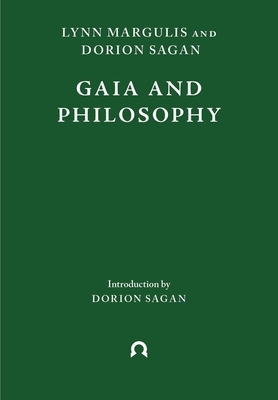
In the 1970s, microbiologist Lynn Margulis and atmospheric chemist James Lovelock developed the Gaia theory. Embracing the circular logic of life and engineering systems, the Gaia theory states that Earth is a self-regulating complex system in which life interacts with and eventually becomes its own environment
Gaia describes a living Earth: a body in the form of a planet. For billions of years, life has created an environment conducive to its continuation, influencing the physical attributes of Earth on a planetary scale. An idea with precedents in natural science and philosophy for millennia, Gaia resonates with the ancient magico-religious understanding that all is one: as above, so below.
Fusing science, mathematics, philosophy, ecology and mythology, Gaia and Philosophy, with a new introduction by Dorion Sagan, challenges Western anthropocentrism to propose a symbiotic planet. In its striking philosophical conclusion, the revolutionary Gaia paradigm holds important implications not only for understanding life’s past but for shaping its future.
Author: Lynn Margulis, Dorion Sagan
Binding Type: Paperback
Publisher: Ignota Books
Published: 06/30/2023
Series: Terra Ignota #3
Pages: 88
Weight: 0.14lbs
Size: 6.31h x 4.56w x 0.26d
ISBN: 9781838003968
Language: English
Reviews
There are no reviews yet.